So the first week runs on shadowing. A new sales rep sits next to a senior one and tries to absorb the pitch by osmosis. A new engineer waits for a teammate to have a free hour to explain the deploy flow.
The manager who knows how everything works becomes everyone's bottleneck, answers the same questions for every cohort, and quietly loses a day a week to it. The new hire, meanwhile, spends their most motivated moments waiting.
None of this is a hiring problem or a motivation problem. It is a documentation problem wearing a costume. Faster onboarding is not something you buy or something you hire for. It is something you write down once and reuse.
For the tool side of this decision, see our guide to employee onboarding software. This piece is about the thing any tool has to carry: the documented onboarding process itself.
Key takeaways
- Slow onboarding is usually a symptom of undocumented, person-dependent process — not weak hires or weak managers.
- The lever that shortens time-to-productivity is a documented onboarding process: a checklist, role-specific paths, and reusable step-by-step assets a new hire can follow without a live escort.
- Capture the work as it is actually performed instead of writing it from memory; a workflow captured while you do it costs minutes, while the same guide written from scratch costs one to two hours.
- Measure onboarding by time-to-first-productive-week and first-year retention, not by whether the checklist got ticked.
- A documented onboarding system is low-maintenance when it is captured close to the work and owned by someone — not a static binder that goes stale the week you finish it.
What faster onboarding actually means
Faster onboarding is not a shorter orientation. It is a shorter distance between a hire's start date and the day they do real work without supervision.
The metric that matters is time-to-productivity: how long it takes a new hire to complete the core tasks of the role at the expected quality, unassisted.
For a sales rep, that might be the first booked meeting or first closed deal. For an engineer it might be the first merged commit or first solo on-call shift. The exact milestone changes by role. The shape of the problem does not.
Onboarding faster means moving that milestone earlier without cutting corners on quality. You do that by removing the two things that stretch ramp time: waiting for a human to be available, and relearning the same answer the last cohort already learned. Documentation removes both.
A documented step-by-step process is available at 9 a.m. on a Tuesday whether or not the one person who knows it is in a meeting.
Why most onboarding stays slow
Most onboarding fails the same way. It depends on a person, and people do not scale.
Watch how ad-hoc onboarding actually behaves. The knowledge exists; it just lives in the heads of your most capable people, who are also your busiest. So onboarding gets rationed to whenever they have a free hour.
Because it is verbal, it is different every time; the third rep to join hears a slightly different version of the pitch than the first. Because it is verbal, none of it compounds. You pay the full teaching cost again for every single hire.
Then there is the objection that keeps teams from fixing it. We are moving too fast to document, and docs go stale the moment we write them. Both halves are true of the wrong kind of documentation; the 40-page onboarding binder written from memory in a quiet week, obsolete the moment a tool changes its interface. That binder is exactly what you should not build.
The failure is not that onboarding teams lack care.They lack a system that lets care scale past the number of hours in one senior person's week. Shadowing feels thorough because it is high-effort.
But effort is not the same as leverage, and a process you have to perform live for every hire has no leverage at all.
How process documentation shortens time-to-productivity
Here is the reframe the rest of this article runs on. The goal is not to produce more onboarding content. It is to make each hire's ramp independent of any one person's calendar.
Process documentation does that in three ways.
It makes the process repeatable. When the steps to configure a dev environment, run the first customer call, or submit the first expense report exist as a follow-along guide, every new hire gets the same version: the good version. They don't need a senior person standing beside them narrating it live.
The teaching cost is paid once and reused. We see teams go from onboarding one hire at a time to onboarding a full cohort with the same manager effort, because the manager is now reviewing outcomes instead of reciting steps.
It moves the expert from narrator to reviewer. This is the quiet unlock. When the happy path is documented, your senior rep or lead engineer stops answering "how do I do X" and starts answering "here is what I did, is it right."
That confirmation is where their expertise actually adds value. Everything before it was transcription.
It shortens the feedback loop for the new hire. A hire who can attempt real work on day three (following a documented flow, then getting it checked), learns faster than one who spends day three waiting to be shown.
Doing beats watching. A documented process lets a new hire do far earlier than a shadowing model ever allows.
The economics only work if capturing the process is cheap. This is where write-from-memory documentation breaks and capture-first documentation wins.
Recording a workflow while you actually perform it takes minutes. Writing the same guide from scratch, screenshotting and annotating each step from memory, takes one to two hours and is wrong by next quarter.
Capture, not recall. A process captured as it is performed is both faster to make and more accurate, because it is a recording of reality rather than a description of it.
None of this requires relearning how to write a procedure. For the underlying method, see our 7-step framework for creating SOPs, this article is about pointing that method at onboarding specifically.
Building a documented onboarding system, step by step
A documented onboarding system is four assets working together: a checklist, role-specific paths, captured step-by-step guides, and one owner. Here is how to build it without stopping the work you already have.
Step 1: Map the first productive week backward from the outcome
Do not start by listing everything a hire should eventually know. Start from the productivity milestone and work backward. Ask the senior person in the role a single question: what does this person need to be able to do, unassisted, by the end of week one?
For a support rep that might be "resolve a tier-one ticket end to end." Everything that does not serve a week-one outcome moves to week two or later. You are sequencing by time-to-productivity, not by org-chart completeness.
Step 2: Build the onboarding checklist as the spine
The checklist is the skeleton the rest hangs on. It is not the documentation; it is the ordered list of what happens and in what sequence, with each item linking to the guide that explains it.
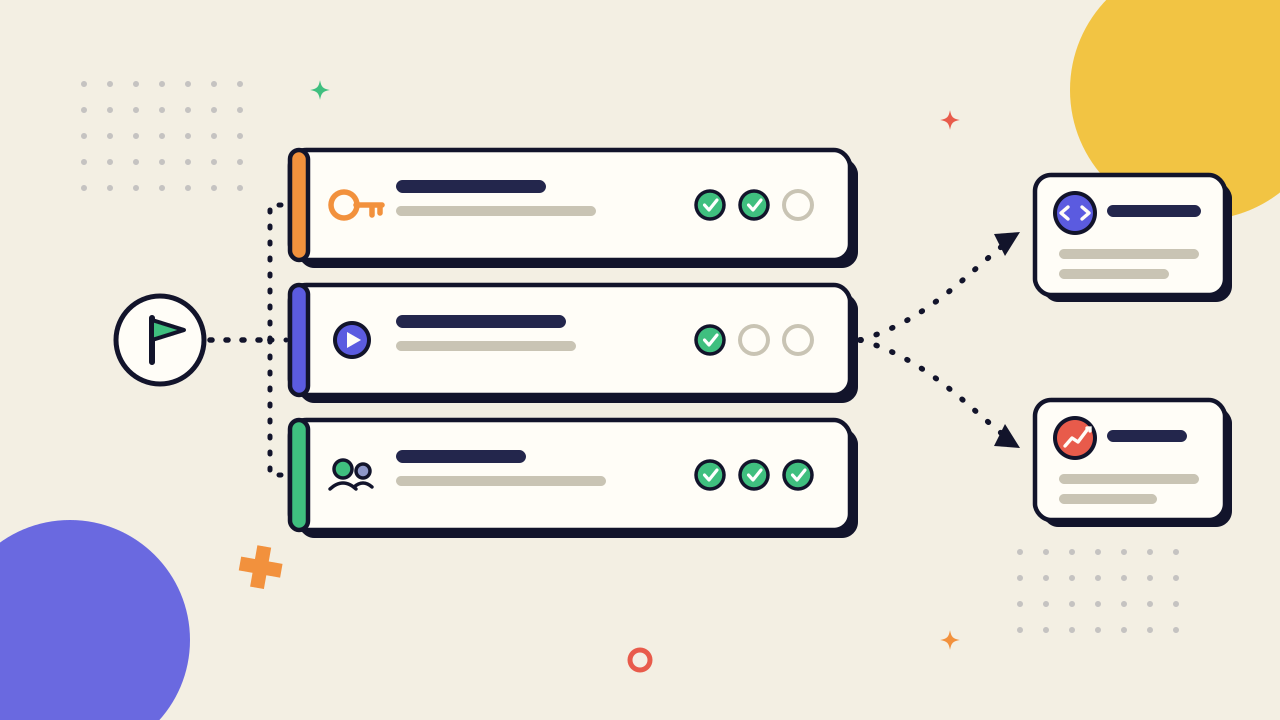
Split it into three lanes that run in parallel: access and setup (accounts, permissions, and day-one IT readiness), role training (the actual work), and context (who owns what, and how the team communicates).
A good onboarding checklist is boring on purpose. Its job is to guarantee nothing gets skipped, not to teach.
Step 3: Capture the core workflows as you perform them
This is the step that makes or breaks maintenance cost. For each real task on the checklist, capture it while someone does it for real; record the actual flow, the actual clicks, the actual screens. Do not write it from memory afterward.
Capture the happy path first; edge cases come later and clutter a new hire's first run. A captured guide is faster to produce, and when a screen changes you re-capture that one step instead of rewriting a document.
This is what keeps the "docs go stale" objection from coming true.
Step 4: Create role-specific paths, not one generic track
A new engineer and a new account executive should not walk the same onboarding. Build the shared setup once, then branch into role-specific paths that reuse common assets. The security-and-tools module is written once and appears in every path; the role training differs.
This is where reusable assets pay off. You assemble a new role's onboarding largely from guides you already captured, in the time it used to take to write one from scratch.
Step 5: Assign an owner and a review trigger
An onboarding system with no owner is a binder with extra steps. Name one person accountable for the process. Not for teaching it, for maintaining it.
Give them a review trigger tied to reality rather than the calendar: when a tool changes, when a role's responsibilities shift, or when a new hire flags a guide that no longer matches the screen.
Ownership over the process is the difference between a system that stays true and one that quietly drifts. Documentation without an owner is a decision to let it rot politely.
Common mistakes when documenting onboarding
Most onboarding documentation fails in predictable ways. Each maps to a skipped step above.
Documenting for completeness instead of productivity. Teams try to capture everything a hire will ever need and bury the week-one essentials under reference material. The fix is Step 1: sequence by what unlocks productive work first.
Writing from memory instead of capturing from reality. This produces the two-hour guide that is wrong by next quarter and the maintenance burden that makes everyone give up. Capture live instead.
One generic track for every role. A single onboarding path forces every hire through irrelevant material and teaches no one their actual job efficiently. Branch by role.
Confusing the checklist with the training. A checklist that tries to also teach becomes an unreadable wall of text; a training set with no checklist lets things get skipped silently. Keep the spine and the guides separate.
Shipping it and walking away. The most common failure. No owner, no review trigger, and the system that was accurate in January describes software that no longer exists by June. Fix the process, do not blame the new hire who followed a stale guide.
Measuring whether onboarding is actually faster
If you cannot measure ramp time, you cannot claim you improved it. Pick a small number of outcome metrics and watch them across cohorts.
Time-to-first-productive-week is the anchor: the days between start date and the first unassisted completion of the role's core task. Track it per role, and track the trend across hires, not any single number.
A documented system should bend this curve down over successive cohorts as the assets improve and coverage widens.
First-year retention is the outcome that pays for the whole effort. New hires who reach competence quickly are far likelier to stay.
The ones who flounder in an unsupported first month are the ones who leave inside the first year and force you to re-run the entire hire-and-ramp cost.
Faster, better-supported onboarding is a retention lever, not just a speed one.
Manager hours per hire is the leading indicator that your system is working. If the senior person's time per new hire is falling while quality holds, the documentation is doing the teaching and the expert is doing the reviewing.
Do not measure completion of the checklist as if it were the goal. A ticked checklist tells you the box was checked, not that the person can do the work. Measure the work.
There is a human argument here too, underneath the metrics. A documented, followable onboarding is a form of respect for a new hire.
It tells them their first weeks were worth planning for, that you did not expect them to reconstruct the job from overheard hallway answers. People remember whether their first month felt designed or improvised.
How AI is changing employee onboarding in 2026
AI is changing the cost of the hardest part of onboarding documentation: producing and maintaining the step-by-step guides. It is not changing what makes onboarding fast.
Three shifts are real in 2026.
Auto-generated step descriptions. AI turns a captured workflow into written, editable steps, so the minutes-to-capture number drops further and the person recording does not also have to write.
Draft-and-refine maintenance. When a screen changes, AI can regenerate the affected step from a fresh capture instead of a human rewriting it, which is what finally makes "keep docs current" cheap enough to actually happen.
Personalized paths. Role and prior-experience signals can tailor which modules a hire sees, so a senior engineer skips the git basics a new grad needs.
For a deeper look at generating onboarding walkthroughs this way, see our guide to speeding up onboarding with AI-generated step-by-step guides.
Be honest about the limits, though.
AI drafts steps; it does not know your rules, your exceptions, or which customer you must never route to self-serve. It speeds up production of the process, not the design of it.
The judgment about what a new hire needs to be productive in week one is still yours. AI makes a well-designed onboarding system cheaper to build and maintain. It does not rescue a system nobody designed.