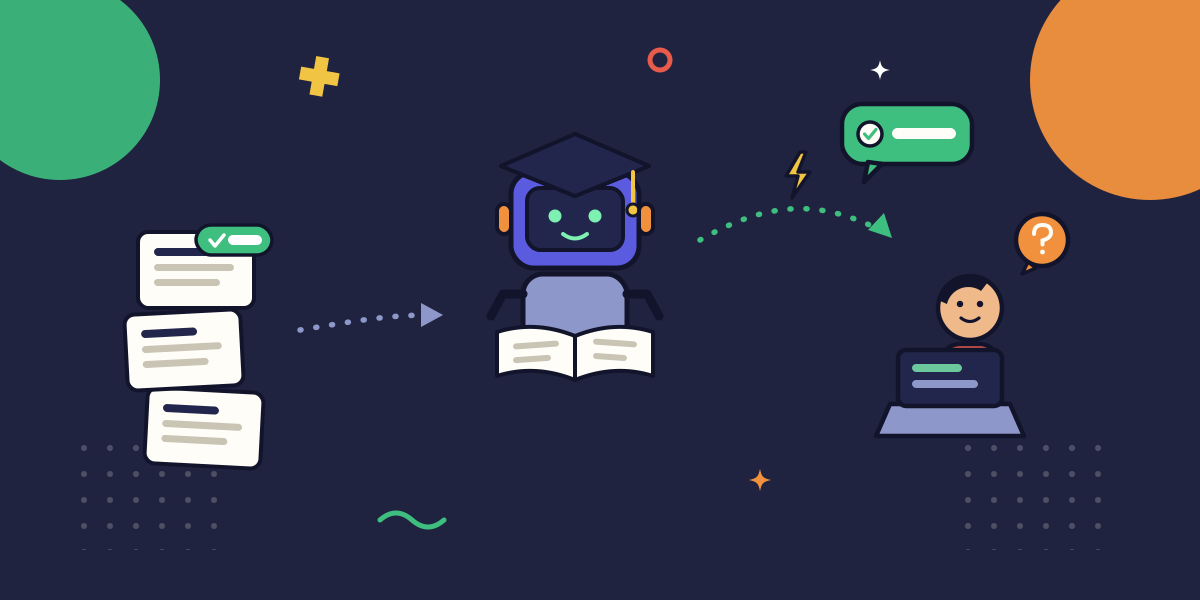
That is both the promise and the problem. AI does not know what your team knows. It only knows what your team has captured, and it will teach whatever it finds with the same fluent confidence whether the source is current or two years stale.
The shift that matters is not that AI can now teach your people. It is that your documentation just became what your people are taught from.
This piece is about what changes in how employees learn and how knowledge moves through a team once AI is in the loop, and what has to be true underneath for any of it to work.
Key takeaways
- AI's real leverage in training is not content generation. It is adaptivity and instant, in-the-flow knowledge retrieval, and both run entirely on your existing source material.
- Training is shifting from an event you schedule to an answer delivered at the moment of need, which sidesteps the forgetting curve that quietly wastes most classroom-style training.
- Personalized learning amplifies whatever it is built on. Point it at a wrong or stale source and you have built an efficient way to teach the wrong thing to the person most likely to act on it.
- The failure mode of an AI copilot is a confident, well-formatted, wrong answer. Accuracy is now a governance problem, not a model problem.
- The goal is not to let AI teach your team. It is to make your team's knowledge worth teaching from.
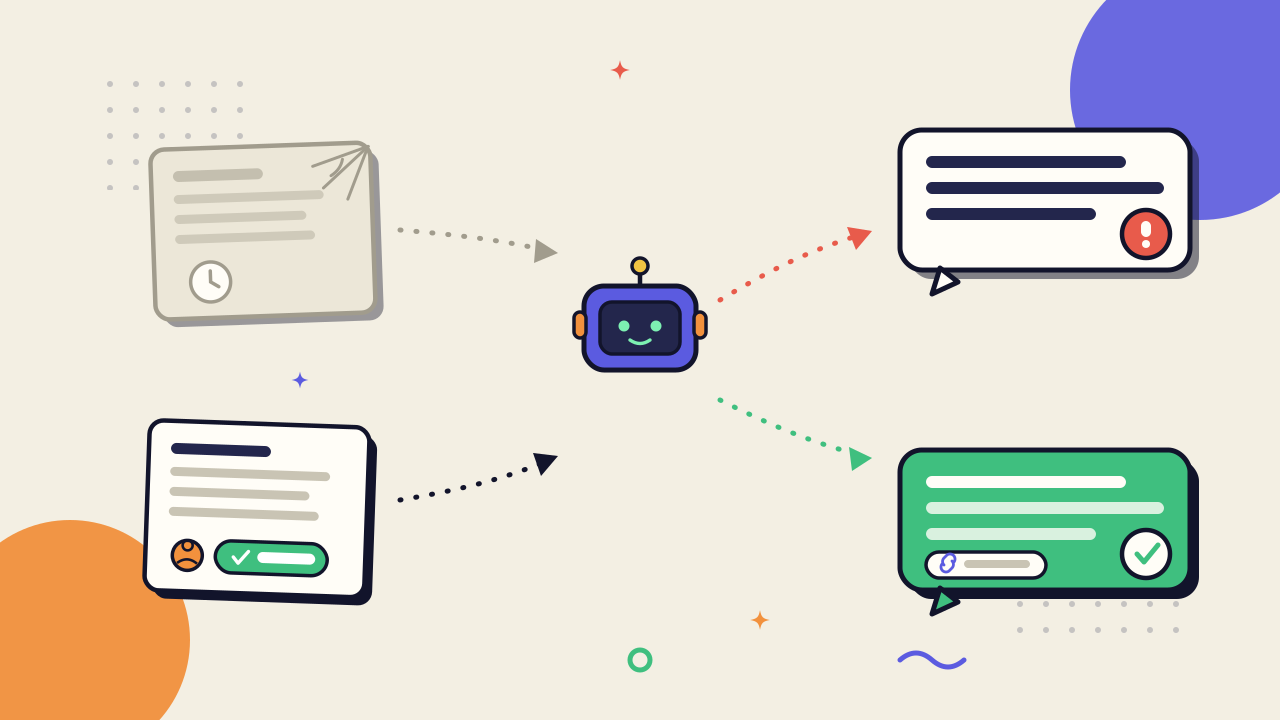
AI in workplace training
For most of history, workplace training has been an event. You gather people, push content at them during an onboarding week or an annual module, and hope enough of it survives until the day they need it.
The uncomfortable truth is that learning science has known since the 1880s, when Hermann Ebbinghaus first described the forgetting curve, that most of what you teach in a block decays within days unless something reinforces it. Event-based training fights that curve and usually loses.
From scheduled training to real-time guidance
AI changes the shape of the problem by moving the teaching to the moment of need. Instead of asking a new agent to remember, three weeks after onboarding, how to reset a customer's multi-factor authentication, an AI assistant answers the question the instant the ticket lands, in the tool where the work is already happening. The lesson arrives exactly when it is needed. Instead of a course, training becomes retrieval in the flow of work.
Two capabilities do most of the work here. The first is in-the-flow retrieval: a copilot that pulls the relevant procedure, policy, or answer out of your knowledge base on demand, so the knowledge lives one question away instead of one wiki-search away. The second is adaptive delivery, which we come to below. Together, they blur the line between training and doing the work.
Why onboarding changes first
Onboarding is where this shows up first and most visibly, because a new hire's first month is one long sequence of moments of need. We cover AI-generated step-by-step onboarding guides separately, but the same approach, delivering answers in context, extends far beyond onboarding to every task an employee performs.
Training used to be something you finished. Now it runs quietly in the background of the work, and the question is no longer whether your people attended it. It is whether the thing answering their questions is telling them the truth.
AI-generated docs
This is where the two halves of the story connect. The knowledge an AI trains from and retrieves from is increasingly knowledge that AI helped produce. Documents, SOPs, and guides that once took hours to create can now be drafted from a screen recording or rough capture in minutes. We cover how AI generates documentation and the ROI of AI-generated documentation separately. Here, the focus is what happens after those documents exist.
What matters for training and knowledge sharing is the second-order effect. When producing a document drops from 90 to 120 minutes to just 8 to 15, keeping source material current stops being the chore teams skip. Current source material is the whole game for a training layer built on retrieval. An AI copilot is only as right as the most recent document it can find.
AI-generated documentation is more than a writing shortcut. It becomes the supply line for everything the AI later teaches. That shifts documentation from a records-management task to an enablement function, because the quality of every answer employees receive depends on the quality of the documents behind it.
Personalized learning
Adaptive delivery is the second capability, and it is where the promise gets most interesting and most oversold.
What AI changes
Personalized learning means the path adjusts to the person: it skips what someone has already demonstrated they know, slows down where they are struggling, and sequences material to the individual rather than the cohort.
Good instructional designers have wanted this for decades. Mastery-based progression and spaced repetition are not new ideas. What AI changes is not the theory. It is the ability to deliver those ideas one-to-one at scale across real workflows, not just flashcard-style recall.
In corporate L&D this might mean a compliance or product-training module that stops making a ten-year veteran sit through fundamentals she could teach, and instead focuses on the two policy changes that are genuinely new to her. In a contact center, it means adaptive training that targets the call types an agent actually struggles with rather than sending every agent through the same curriculum. The training compresses toward the individual's actual gap.
Personalization amplifies its source
Personalization has a property people often forget: it amplifies whatever it is built on. A system that delivers exactly the right material to exactly the right person, at exactly the moment they need it, is a powerful multiplier. Point that multiplier at a wrong or outdated source and you have not built better training. You have built the most efficient possible way to teach the wrong thing to the person most likely to act on it immediately. Precision is only a virtue when the thing you are being precise about is correct.
The point of personalized learning was never personalization. It was getting the right knowledge into the right head at the right time, and "right knowledge" is the load-bearing phrase. Change the source and you change the answer, at scale, for everyone.
Risks/challenges
The standard objection to AI in training is that it is hype: generic content, hallucinated answers, no measurable learning outcome. That objection is half right, and it is worth being specific about which half, because the real risks are not the ones the skeptics usually name.
Confident wrong answers. A human expert who is unsure says, "Let me check." An AI copilot does not. It retrieves the closest-matching document and renders it in fluent, authoritative prose. If that document is stale, the model has just laundered a wrong answer into an official-sounding one. The agent who trusts it passes the error straight to the customer.
That is worse than no documentation. An empty knowledge base makes people ask a human, while a confidently wrong one makes them stop asking. Accuracy in an AI training layer is not a model-quality problem. It is a source-quality problem.
Source-of-truth ambiguity. Most teams do not have one canonical procedure for a task. They have three: the official one in the wiki, the version a senior person actually follows, and the outdated one still linked from an old ticket. A human learns to ignore the dead ones. An AI does not.
When it retrieves, it picks, and you rarely know which version it picked or why. Governance, the unglamorous work of deciding what the single correct source is and retiring everything else, is the precondition for AI training that no demo shows you.
Over-personalization erodes the mental model. A learner who is only ever handed the exact next step, and never the reasoning behind it, gets very good at following and very bad at understanding. They build no model of why, which means they cannot handle the edge case the system did not anticipate.
The most efficient training path is not always the one that produces someone who can still think when the script runs out.
Skill atrophy moves competence out of your people and into the tool. If the copilot always answers, people stop building the internal expertise they used to develop by struggling through problems. That is fine until the day the tool is wrong or unavailable, and you discover the organization's competence migrated into a system nobody on the team fully understands.
The knowledge did not get shared. It got centralized somewhere you cannot see.
Every one of these risks resolves to the same root, and so does the fix. The value of an AI training layer is capped by the trustworthiness of the material underneath it. That makes the highest-leverage work not choosing an AI tool, but getting your source procedures right: one canonical version per task, a named owner, a visible last-verified date, and a process for keeping them current.
That is not an AI project. It is a documentation discipline, the same one that produces good procedures with or without a model on top. Our seven-step framework for building trustworthy source procedures is the place to start.
An AI trained on your best guess will teach the whole team to guess, faster and with more confidence than they ever could alone. Fix the source, and the same system becomes the best trainer you have ever had.
The future of AI knowledge management
Look far enough ahead and knowledge management stops being a place you go and becomes a thing that comes to you. The trajectory is already visible.
Instead of searching a knowledge base, you are answered by it. Instead of noticing a document is stale, you are told. Instead of discovering a gap when a customer hits it, the system flags that a hundred people asked a question this month for which there is no good answer.
Knowledge management turns proactive and conversational, and the sharp edge of the discipline moves from organizing documents to capturing knowledge and keeping it honest. That is one part of the wider shift in process documentation. Training and knowledge sharing is where the change shows up first, because that is where knowledge is consumed.
Here is the part worth internalizing. Everyone will rent the same models. The frontier AI your competitor uses to train their team is the same one you can use to train yours, at roughly the same price, by roughly next quarter. The model is not the moat. The difference is the corpus: whether your knowledge is captured, current, governed, and written down where a system can actually use it.
Which is why the real work is the opposite of what the hype implies. The goal is not to let AI teach your team. It is to make your team's knowledge worth teaching from. Do that, and AI becomes a force multiplier. Skip it, and it becomes a very articulate way to scale your worst documentation.
So before you ask what AI can teach your team, ask the harder question. If a system read everything your team has written down, would it learn the truth?
Get that answer to yes, and AI becomes the best trainer you have ever hired. Leave it at no, and you have automated the spread of your own bad guesses.
The knowledge was always the point. AI just raised the stakes on getting it right.