For years, teams have been stuck between two bad options: blank-page SOPs nobody wants to write, and bloated wikis nobody wants to read.
That is starting to change.
Two trends are driving the shift.
First, AI is moving into the core documentation workflow: drafting, structuring, retrieval, and freshness checks.
Second, capture-first authoring is becoming the default. Teams are realizing it is faster to record how work actually happens than to ask someone to write it from memory.
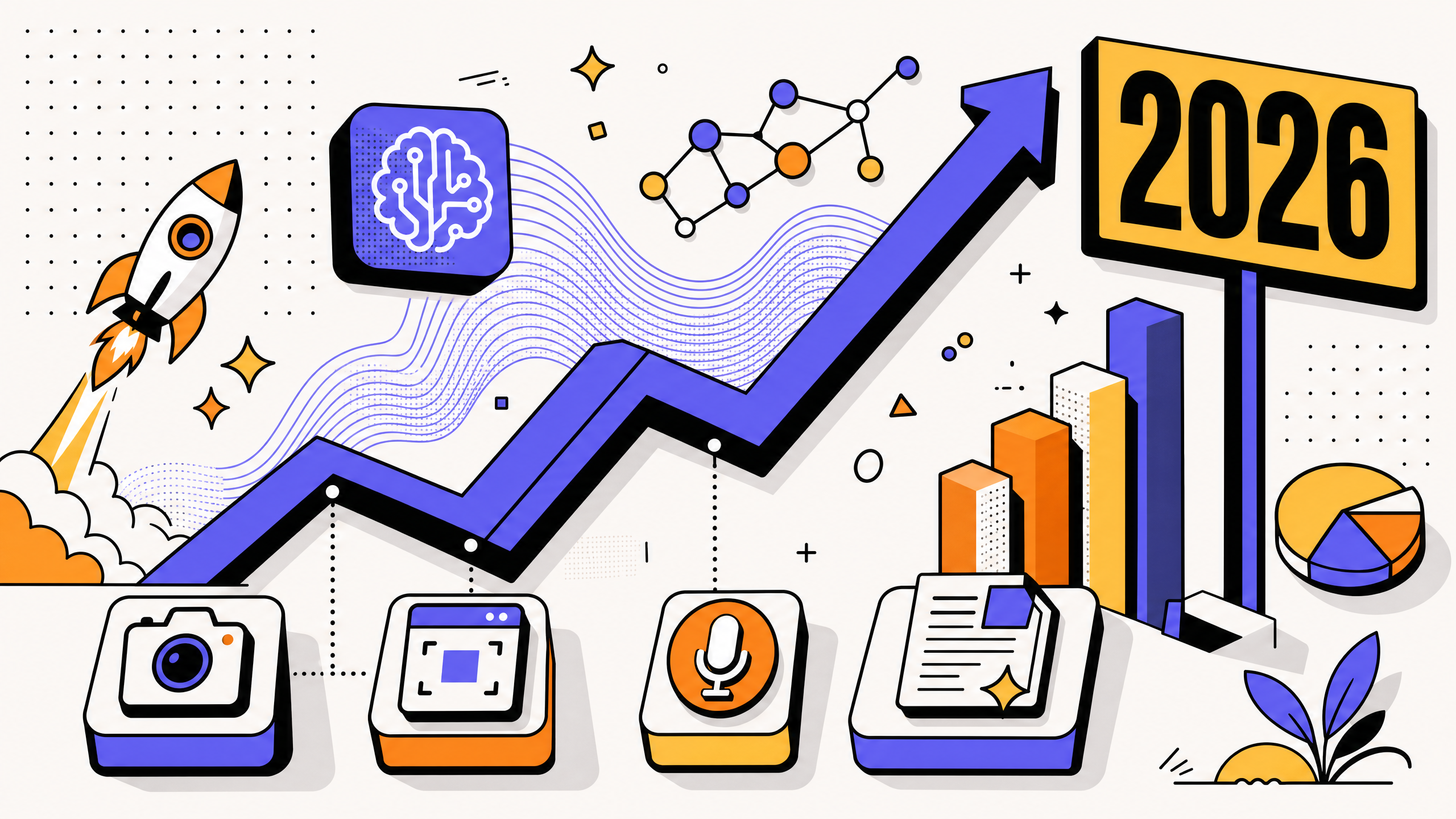
This guide covers eight trends reshaping process documentation in 2026, how AI is changing the discipline, and why capture-first tools are becoming the new standard.
Key takeaways
- Process documentation is moving from a writing-first discipline to a capture-and-structure workflow.
- AI transformation is happening in three layers: input, structure, and maintenance.
- Capture-first tools are gaining ground because they reduce blank-page work and let operators create the first draft by doing the work.
- The “second wiki” problem is becoming one of the most expensive rollout failures.
- Documentation is becoming the data layer for AI assistants and agents. If the docs are stale, the AI will be too.
What is process documentation in 2026?
Process documentation is the practice of capturing, structuring, and maintaining written records of how work gets done.
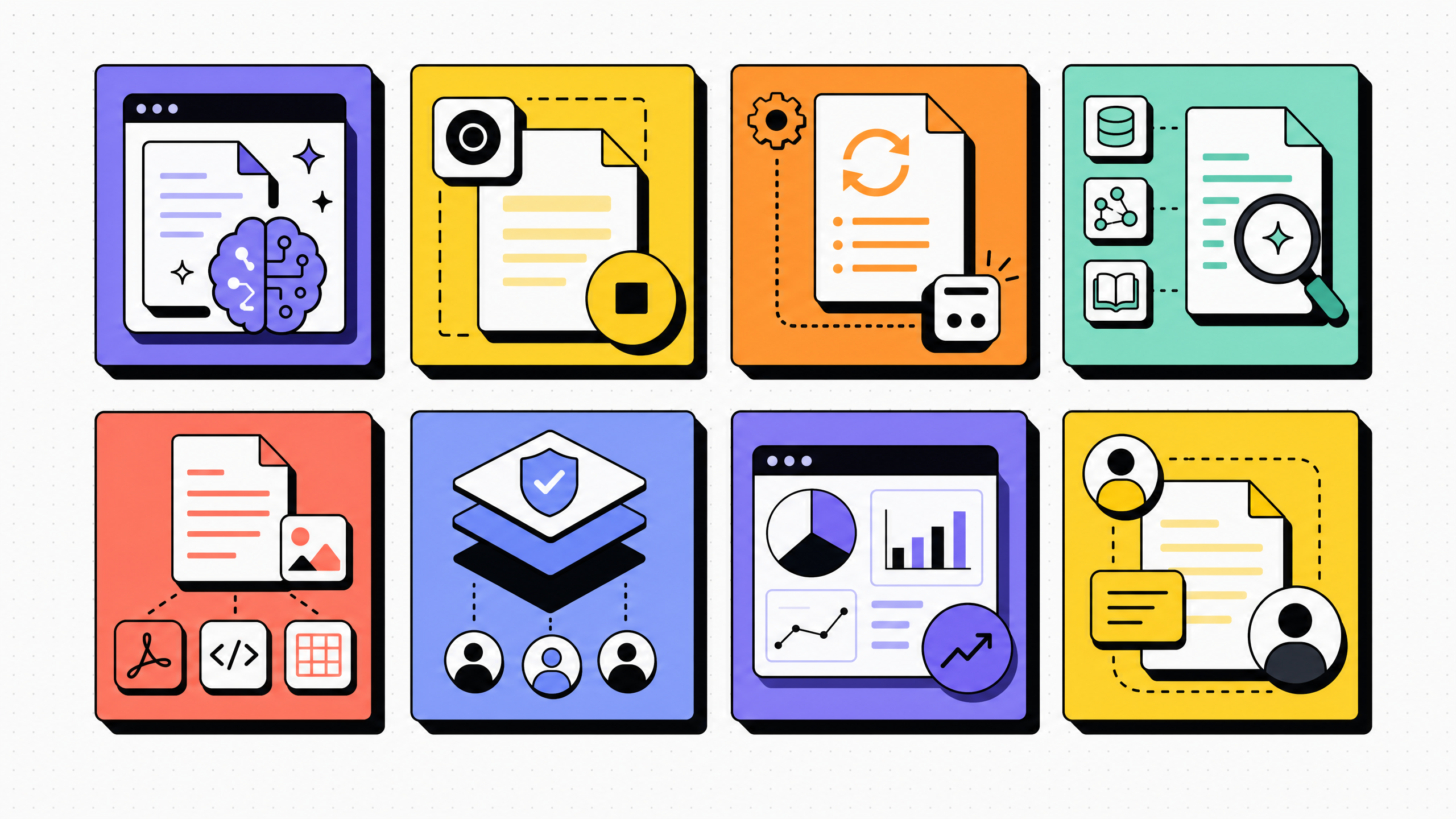
It includes:
- SOPs
- Runbooks
- Decision trees
- Escalation paths
- Workflow guides
- Institutional knowledge
- The purpose has not changed. Operators still need to follow workflows. New hires still need to learn them. Managers still need to review them. Auditors still need to verify them.
- What has changed is how documentation gets created and maintained.
- In 2026, the best process documentation workflows are AI-assisted at the input layer, structured around reusable templates, and supported by freshness checks after publication.
- The goal is no longer “write more docs.”
- The goal is to capture real work, turn it into usable documentation, and keep it current.
For the foundational methodology layer, see our 7-step framework for how to create standard operating procedures. For the AI-assisted authoring layer specifically, see AI process documentation and how AI transforms SOP creation.
8 process documentation trends reshaping the category in 2026
The trends below are listed by operational impact, not novelty.
The first three affect how documentation gets created. The next three affect how it stays useful. The last two affect governance and procurement.
Trend 1: AI-assisted authoring becomes the default, not the experiment
In 2024, AI-assisted authoring was a feature flag. In 2025, it was an opt-in experiment. In 2026, it is the default install. New documentation tools ship with AI drafting in the primary authoring path; legacy tools have retrofitted it as a button next to the old text editor.
The shift is not that AI writes better documentation than humans. It does not. The shift is conversion speed.
AI converts a 30-minute screen recording into a structured 1,500-word draft in under 60 seconds. The human reviewer then cuts the work to 10 minutes of edits. The advantage is in the conversion, not the prose. Teams that have not yet adopted AI-assisted authoring are now visibly slower than teams that have.
Trend 2: Capture-first tools replace blank-page authoring
The blank-page SOP authoring model is in terminal decline. Capture-first tools (record-the-work, structure-the-recording) have crossed from early-adopter territory into mainstream procurement in 2026. Every Haiku audit we ran in Q1 2026 had at least one capture-first tool already in the stack, compared to roughly one in three audits in early 2024.
The reason is not feature parity. It is the input cost. Asking an operator to write down the workflow in prose costs the operator 90 to 120 minutes. Asking the operator to record themselves running the workflow costs 8 to 15 minutes.
The cost differential is large enough to change which person on the team produces the documentation: the operator records, the writer reviews. That role swap is the actual trend.
Trend 3: Multi-language documentation moves from premium feature to baseline
Native multi-language support was a tier-3 feature in 2023. In 2026, it is a checklist item on every RFP. The shift is driven by globally distributed operations teams. They need the same SOP available in English, Spanish, Portuguese, and Japanese. Edits to the source language flag the others as out of date automatically.
Bolt-on translations from a separate vendor are no longer good enough. The handoff between authoring tool and translation tool was always where drift accumulated. AI-driven inline translation, with a glossary file controlling domain-specific term rendering, closes the loop. The 2026 expectation is that a single document exists in N languages and the source-of-truth language is enforced at the platform level.
Trend 4: Change-detection becomes a category, not a feature
Workflow drift was the silent killer of process documentation libraries from 2015 through 2024. The team that updated the staging environment on Monday rarely updated the runbook on Tuesday. Three months later, half the runbook was wrong.
Change-detection inverts the relationship. A modern documentation tool watches for new captures, recordings, ticket resolutions, and code changes that touch the documented workflow. When the underlying workflow changes, the tool flags the corresponding documentation step.
A human owner confirms the change. Drift gets noticed in days instead of quarters. Across our 2025 audits, teams that turned on change-detection saw freshness improve from 38 percent of docs reviewed in the last 90 days to 71 percent.
Trend 5: Question-answering retrieval surfaces above keyword search
Keyword search inside documentation libraries is a 2010s pattern. The 2026 pattern is question-answering. An operator asks "how do I reset a customer's MFA?" in plain language, and the tool returns the specific passage from the right SOP, with a link to the source.
The 2024 problem with retrieval was false-positive answers (the model fabricated steps that were not in the source). The 2026 problem is corpus depth. Retrieval works when the documentation library has enough content for the model to find the right answer.
Most teams in early 2026 do not have enough content yet. The teams that ship retrieval first are the teams that built coverage in 2024 and 2025. Build coverage first, then turn on retrieval.
Trend 6: Documentation becomes the data layer for AI agents
The biggest 2026 shift is downstream. AI agents (customer support agents, sales agents, internal copilots) are now reading documentation libraries at inference time and using the documentation to ground their answers. The documentation is no longer just a human-readable artifact. It is the data layer the AI agent depends on for accurate output.
The implication is uncomfortable for teams with stale documentation libraries: the AI assistant that hallucinates procedures hallucinates because the documentation it reads is wrong. The fix is not better prompting. The fix is fresher documentation. Teams that built thorough documentation in 2023 and 2024 are now reaping a second-order benefit: AI agents that work because the data layer is accurate.
Trend 7: Audit trails meet regulatory pressure
Process documentation has been a compliance artifact for years (ISO 9001, SOC 2, HIPAA, NIST CSF). The 2026 shift is the granularity of the audit trail. Auditors no longer accept "we have an SOP for that". The 2026 expectation is full version history per document, per-step diffs, named owner per workflow, and a verifiable approval chain for high-impact procedures.
The driver is regulatory pressure plus AI scrutiny. When a regulator asks why an automated decision was made, the answer often traces back to the SOP that fed the AI agent. If the SOP version is not pinned to the date of the decision, the audit fails. Modern documentation tools now ship audit-grade version history as a baseline, not a tier-2 feature.
Trend 8: Tool consolidation accelerates as the "second wiki" problem becomes expensive
The most painful documentation pattern of 2024 to 2025 was the "second wiki": a team buys a new documentation tool, copies the highest-trafficked 10 documents into it, and leaves 200 stale documents in the old wiki. Six months later, two thirds of the team still searches the old wiki because that is where their muscle memory lives.
In 2026, buyers have learned this. Procurement teams now require migration plans before signing contracts. The trend is consolidation: teams pick one tool, plan the cutover off the legacy wiki, and treat the migration as a project with a hard deadline rather than a side effect of the purchase. Tools that ship strong migration tooling (bulk import from Confluence, Notion, SharePoint, Google Docs) win procurement. Tools that do not are losing renewal deals in months 18 to 24.
Trend takeaways
AI-assisted authoring, capture-first workflows, and multi-language support are changing how documentation gets created.
Change detection, retrieval, and AI agents are changing how documentation gets used and maintained.
Audit trails and tool consolidation are changing how documentation is governed and bought.
How AI is transforming process documentation in 2026
AI is reshaping process documentation across three layers, and the layers do not arrive at the same speed for any given team. Most teams in early 2026 are deep into phase one (input), starting to deploy phase two (structure), and just beginning to evaluate phase three (maintenance).
Phase 1: input (capture and draft generation)
The most mature AI capability in process documentation is at the input layer. Screen recordings, voice transcripts, and free-form notes are converted into structured drafts by transformer models that understand the typical shape of an SOP. The 2024 version produced first drafts that needed 50 to 80 percent rewrite. The 2026 version produces first drafts that need 10 to 30 percent rewrite.
Time-to-first-draft is the metric that matters at this layer. A workflow that took 90 to 120 minutes to write in 2022 takes 15 to 30 minutes of capture plus 20 to 30 minutes of review in 2026. Teams that have not yet moved to AI-assisted input are visibly slower in 2026 than teams that have. The gap is now hard to defend on anything except rollout inertia.
Phase 2: structure (template enforcement and normalization)
Phase two is where AI fits drafts to templates and enforces structural consistency across the documentation library. Every document carries the same scope, owner, version, prerequisites, numbered-steps, and rollback fields. AI extracts each field from the captured input, fits it to the template, and flags missing fields before publication.
The 2026 distinction is automation. In 2024, fitting a draft to a template was a manual editor task. In 2026, the tool handles it at write time. Phase two reduces the long-tail variance in document quality across a team. The strongest writer no longer authors better-structured docs than the average writer; the template is enforced at the platform level.
Phase 3: maintenance (drift detection and freshness alerts)
Phase three is where AI watches the underlying workflow and the corresponding documentation in parallel, and flags when they diverge. New captures, code changes, ticket resolutions, and configuration updates are compared against the published SOP. When the SOP no longer matches the actual workflow, the tool surfaces the mismatch to the named owner.
Most teams in early 2026 are just beginning to evaluate phase three. Maintenance is harder than authoring because it requires connecting the documentation tool to the source-of-truth systems. Those systems include the SDLC platform, the ticketing system, and the cloud infrastructure. Teams that crack phase three by year-end 2026 are the teams whose documentation libraries will still be trustworthy in 2028.
The rise of capture-first tools
Capture-first tools are the format winning process documentation in 2026. Below are the four sub-trends within the broader capture-first shift, in the order they typically arrive at a team.
What capture-first means
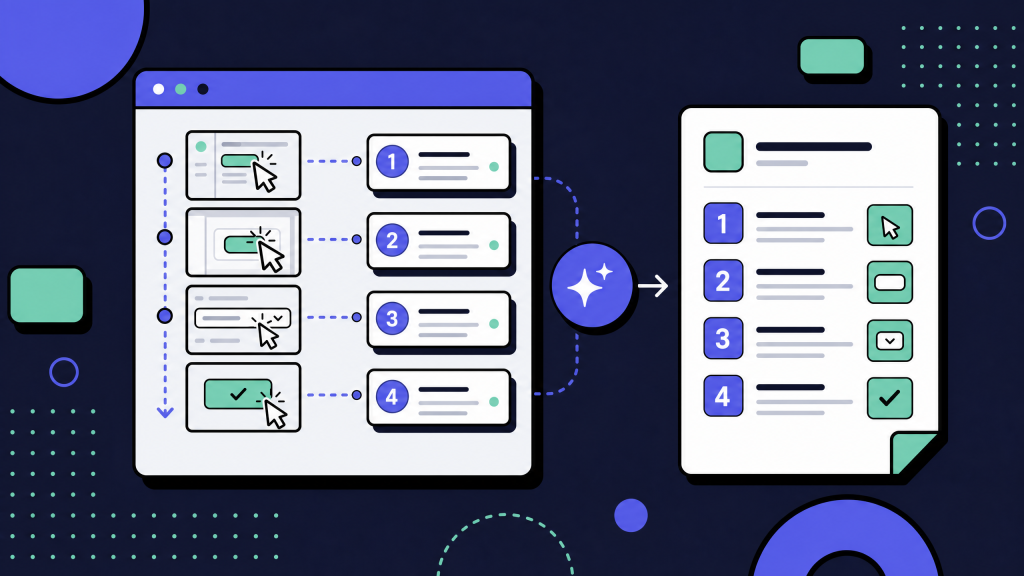
A capture-first tool inverts the documentation creation flow. Instead of asking a writer to describe how a workflow runs, the tool asks the operator to run the workflow once with the recorder on. The operator screen-records the steps or narrates them out loud.
The tool produces a structured draft from the recording. The draft contains numbered steps, screenshots of each interface state, a transcript of any spoken context, and a fitted template.
Capture-first is not the same as screen recording. A screen recording is a video file. A capture-first draft is a structured document with extractable steps, replaceable screenshots, and an accurate transcript. The structured document is what makes the draft maintainable, searchable, and AI-readable downstream.
Why capture-first matters now
The cost differential is the headline reason. Asking an operator to write 1,500 words of prose costs 90 to 120 minutes of operator time. Asking the operator to record 8 to 15 minutes of work costs 8 to 15 minutes of operator time. The 2026 model spends that 60 to 105 minutes of saved operator time on review by a writer who knows the documentation library. The old model spent that time on first-draft authoring by an operator who would rather be running the workflow.
The deeper reason is who authors. In the 2010s and early 2020s, documentation was authored by writers who had to learn each workflow before they could write it. In 2026, capture-first authoring lets the operator author the first draft simply by doing the work. The writer becomes an editor, not a researcher. The role swap is more durable than the cost saving.
Who adopts capture-first first
Customer support teams adopted capture-first tools earliest, starting in 2022 and reaching majority penetration by mid-2024. The reason is the fit: support workflows are short, repetitive, and high-volume, which is exactly the work pattern capture-first tools optimize for.
In 2025, IT operations and onboarding teams adopted capture-first tools at scale. Their workflows are slightly longer and more branched than support, but the same logic applies. By Q1 2026, the next adoption wave is finance operations, security operations, and engineering runbooks. Teams in industries with heavy compliance burdens (healthcare, financial services) are still cautious because the audit-trail requirement is more stringent. The 2026 tools that ship audit-grade history are starting to win those late-mover deals.
For a side-by-side comparison of the capture-first SOP tools competing for these adoption waves, see our guide on Tango alternatives.
What capture-first replaces
Capture-first replaces three things: blank-page Word documents, generic wikis used as documentation systems, and video-only training libraries with no structured content. The losers are 2010s-era documentation tools without capture support, screen recording tools without structuring layers, and the long-tail of teams who think their documentation problem is a willpower problem. The willpower framing was always wrong; documentation is a tooling problem with a methodology layer on top.
For the broader pattern behind this trend, see how teams are documenting workflows without writing a single word.
What this means for documentation teams in 2026
The 2026 trends above are not optional. They are reshaping how every team that depends on process documentation operates. The implications differ by team size and maturity. For the buying-side framework that turns these trends into a tool decision, see our guide on process documentation software.
For small teams (under 25 people)
A small team that has under-invested in process documentation has the easiest 2026 upgrade path. Pick a capture-first tool, document the top 10 workflows, and turn on retrieval. The whole stack costs less than one full-time hire, takes a quarter to roll out, and pays back in the first onboarding cycle.
The trap for small teams is over-purchasing. Buying a tool optimized for a 500-person operation when the team is 15 people leaves 90 percent of the feature surface unused and the team paying for governance they do not need. Tier the buying decision: light-tier capture-first tools fit small teams; the heavy-tier governance is for later.
For mid-sized teams (25 to 200 people)
Mid-sized teams are where the 2026 trends compound fastest. Capture-first authoring at the input layer plus change-detection at the maintenance layer plus retrieval at the consumption layer is a 6 to 9 month project that pays back in reduced ramp time, fewer escalations, and lower documentation drift.
The trap for mid-sized teams is the "second wiki" problem. They buy the new tool but never finish the migration off the legacy system. Plan the cutover before signing the contract. Set a hard deadline. Communicate the deadline to the team. Without that, the new tool becomes wiki number two.
For large teams (200+ people)
Large teams have the highest absolute impact from the 2026 trends and the hardest rollout. Tool consolidation, audit-grade governance, and AI agents at the consumption layer all matter. The complexity is in the integration surface: connecting the documentation tool to the SDLC platform, the ticketing system, the SSO provider, and the compliance reporting stack.
The trap for large teams is treating the rollout as a single project. The 2026 best practice is a phased rollout: capture-first authoring first (one team at a time), template enforcement second, change-detection third, retrieval and AI agents last. Teams that try to do all four in parallel ship none of them well.
Implication takeaways
Small teams should start with capture and the top workflows.
Mid-sized teams should combine capture, templates, owners, and migration planning.
Large teams should phase the rollout and treat integrations as the real risk.
FAQ
What are the biggest process documentation trends in 2026?
The biggest trends are AI-assisted authoring, capture-first tools, multi-language documentation, change detection, question-answering retrieval, documentation as a data layer for AI agents, stricter audit trails, and tool consolidation.
What is AI process documentation?
AI process documentation uses AI to draft, structure, retrieve, translate, and maintain documentation about how work gets done. The most mature use case is turning captures, transcripts, or notes into structured drafts.
What is capture-first documentation?
Capture-first documentation starts by recording or narrating the workflow. The tool then turns that capture into a structured guide with steps, screenshots, and editable text.
Will AI replace technical writers?
No. AI reduces the mechanical parts of the job: drafting, formatting, translation, and retrieval. Technical writers still own structure, clarity, accuracy, review, and information architecture.
How do I prepare my documentation team for AI?
Start with one workflow. Capture it, turn it into a structured draft, review it with the operator, and compare it to your current process. Add templates, review cadence, and retrieval only after the basics work.
Is screen recording the future of SOPs?
Screen recording is the input, not the final product. The future is capturing the work and converting it into a searchable, editable, structured guide.
What is the difference between traditional and AI-driven process documentation?
Traditional documentation starts with manual writing and manual updates. AI-driven documentation starts with capture, uses AI to structure the draft, and supports maintenance with review workflows and drift detection.