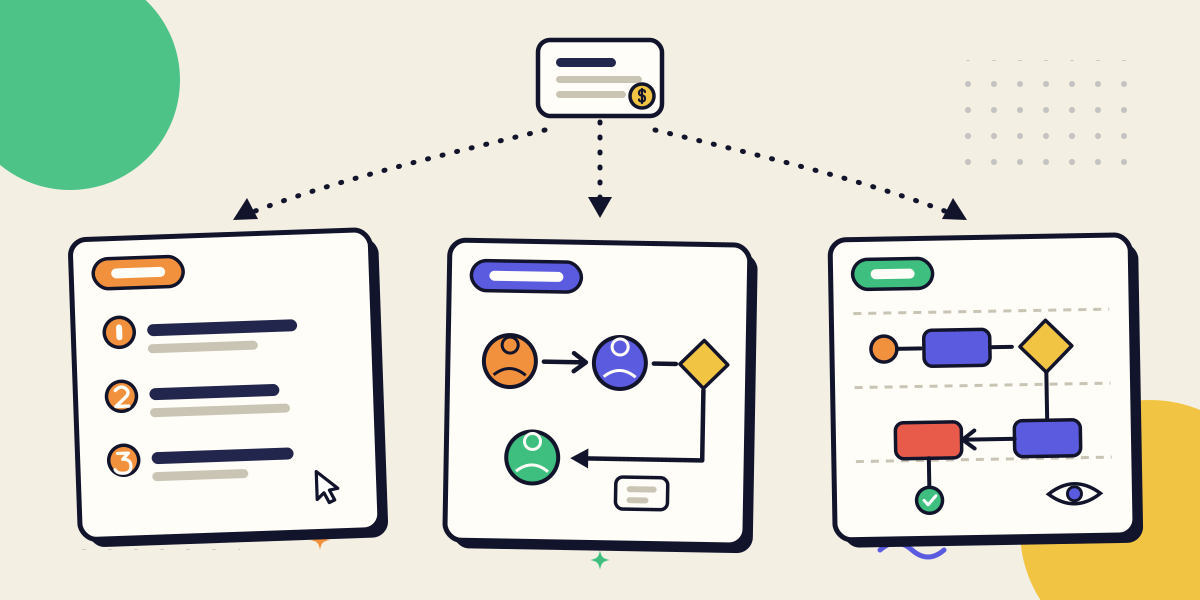
They get used as if they were. A manager asks for "the SOP," pictures the diagram on the wall, and receives a forty-step document nobody will finish. Someone else builds a careful flowchart to answer "how do I actually do this?" and leaves the reader stranded at the very first box. Three words for three different artifacts, and most of the confusion in a documentation project traces straight back to reaching for the wrong one.
This piece draws the boundary between them. It is not a guide to writing a procedure (for that, see our a step-by-step framework for creating SOPs), and it does not explain what process documentation is, the category all three belong to. Instead, it shows you how to tell an SOP, a workflow, and a process map apart, and how to pick the right one for the job in front of you.
Key takeaways
- An SOP, a workflow, and a process map answer three different questions: how to do a task, how work moves between people, and what the whole process looks like.
- The goal is not to pick the most official-sounding format. It is to pick the one that answers the question your reader is actually asking.
- An SOP is instruction for one person doing one task; a workflow is the sequence of roles and handoffs; a process map is the visual diagram of that flow.
- They separate cleanly on four axes you can check in seconds: purpose, level of detail, audience, and format.
- Most documentation trouble comes from using one artifact to do another's job — a diagram asked to teach a beginner, or a written procedure asked to show a whole process at a glance.

What are SOPs, workflows, and process maps?
The short version: an SOP tells you how to do a task, a workflow shows how that work moves through a team, and a process map draws the movement as a picture. Same underlying work, three different views of it.
A standard operating procedure (SOP) is a written, step-by-step set of instructions for performing one task correctly and consistently, whoever is assigned to it. It answers a single question, "how do I do this?", and it answers in detail: the clicks, the fields, the decisions, the order. An SOP assumes the reader's seat and hands them the task.
A workflow is the sequence of steps, roles, and handoffs a piece of work passes through from the moment it starts to the moment it is finished. It answers a different question: how does this move, and who touches it along the way?
A workflow cares less about how any single step is performed and more about the relay: the points where the work changes hands and a new person becomes responsible.
A process map is a visual diagram of a process: boxes for tasks, arrows for sequence, diamonds for decision points, lanes for who owns what. It answers a third question: what does the whole thing look like?
Most process maps follow a familiar visual grammar, whether a plain flowchart or a formal notation such as BPMN (Business Process Model and Notation), so that the same shapes mean the same thing to everyone reading them.
Hold the three side by side and they sort themselves by altitude. The SOP zooms all the way in, to one person's hands. The process map pulls all the way out, to the whole shape on a page. The workflow sits in the middle, riding along with the work as it moves. None of them is a more advanced version of the others. They are three different distances from the same job.
One process, three artifacts: a procurement approval shown three ways
The fastest way to feel the difference is to take one ordinary process and render it three ways. Use a vendor invoice approval: a new invoice arrives and has to be approved before finance pays it. Nothing exotic. Every company runs some version of this. Watch how the same work looks from each of the three distances.
The SOP: how the accounts-payable clerk does it
The SOP is written for the clerk. It reads like a set of instructions, because it is one: open the invoice in the accounting system, match it against the purchase order, confirm the amounts agree, then route it for approval based on the total. If the invoice is under five thousand dollars, it goes to the department manager; at five thousand or above, it goes to the department head and then to finance for a second review.
This is the most detailed of the three artifacts and the narrowest. It covers one role's part of the job in enough depth that a new hire could do it on their first day without asking anyone. What it deliberately does not show is the invoice's whole journey. The clerk sees their own steps, not what happens to the invoice after it leaves their hands.
The workflow: how the invoice moves between people
Pull back one level and the same process becomes a relay. The requester submits the invoice, the clerk validates it, an approver signs off (the manager below the threshold, the department head above it), and finance runs the final review before payment is released. Every arrow in that chain is a handoff: a moment the work changes owner and someone new is on the hook to move it forward.
The workflow's job is to make those handoffs and that conditional branch explicit, so nothing sits in a queue with no name against it. It carries far less step-level detail than the SOP. It carries something the SOP leaves out entirely: the sequence, and the ownership that travels with it.
The process map: what the whole approval looks like at a glance
Pull back all the way and you draw it. Three swimlanes, one each for the requester, the approver, and finance. A rectangle for every task, a diamond where the path forks on "five thousand dollars or more?", arrows threading the boxes together, and an end point where payment completes. Now the entire process is a single picture you can pin to a wall.
A new controller can read the whole shape in about ten seconds, seeing where the branch lives, which approvals run in sequence, and where a bottleneck would form, all without reading a line of procedure. The map is the least detailed per step and the most complete as a whole. It trades depth for a view.
Same invoice, same work, three artifacts. The SOP is built for the person in the seat, the workflow for whoever coordinates the handoffs, the map for anyone who needs to grasp the whole thing fast. The question is never which of the three is better. It is which one answers the question being asked.
Key differences: four axes that separate them
Rather than a comparison you have to decode, hold the three artifacts against four axes. On each one, they separate cleanly.
- Purpose. An SOP exists to make a task repeatable, so a different person gets the same result. A workflow exists to coordinate, so work keeps moving and never stalls between owners. A process map exists to make a process visible, so people can understand, analyze, or improve it. Instruction, coordination, comprehension.
- Level of detail. The SOP is the most granular: every field and decision spelled out. The workflow keeps the sequence and the handoffs and drops the click-level detail. The process map is the most abstract, compressing a whole process into a page of shapes.
- Audience. The SOP is written for the doer, whose hands are on the task. The workflow is for the coordinator: the manager, ops lead, or automation that has to keep the baton moving. The process map is for the observer, whether a new hire orienting, an analyst hunting the bottleneck, or an auditor confirming the shape.
- Format. The SOP is prose and numbered steps, often with screenshots. The workflow is a sequence, whether a list, a checklist, or an automation configured in a tool. The process map is a diagram, usually drawn in a standard notation such as BPMN or a plain flowchart.
Name which of those four you actually need: repeatability, coordination, or comprehension, at task, sequence, or whole-process altitude. Do that, and you have already chosen your artifact.
When to use an SOP, a workflow, or a process map
Reach for an SOP when the risk is that the task gets done differently, or wrong, depending on who does it. Onboarding a new hire, locking down a compliance-sensitive step, or capturing a task that lives only in one person's head all call for the how-to-do-it artifact.
Once you know you need one, building it well is its own discipline, and the format you choose decides whether it survives its first tool update; SOP template patterns that survive UI changes is a good place to start.
Reach for a workflow when the problem is movement rather than method. Work stalls in someone's inbox, handoffs are fuzzy, two people each assume the other owns the next step. Those are coordination failures, and the workflow is the artifact that makes the relay explicit. Increasingly, it's also the thing you hand to an automation.
Reach for a process map when the risk is that nobody can see the whole. Before you can redesign a process, you have to look at all of it at once; before you can cut a bottleneck, you have to find it. The map is the artifact for understanding and improving a process rather than executing it.
Most documentation projects need more than one artifact. Map the process to see it, define the workflow to coordinate it, then write an SOP for each task a person actually performs. They are layers, not rivals. Picking the right layer for each job makes the work easier for the next person who inherits it.
Common mistakes when telling them apart
The confusion is not academic. Reaching for the wrong artifact carries a predictable cost, and the same three mistakes repeat.
The one we see most often is asking a diagram to teach a task. A team maps the process, hangs the flowchart in the wiki, and calls the work documented. Then a new hire stares at a box labeled "reconcile the account" with no idea what to click.
A map shows the shape; it was never built to hold the step-level detail a beginner needs. The repair is to pair the map with SOPs for the tasks inside it.
The mirror-image mistake is asking a written procedure to show a whole process. Someone writes a forty-step SOP that tries to cover every role and every branch, and it collapses under its own weight, too long to follow and too tangled to see.
That is one of the top mistakes teams make when creating SOPs: a document doing a map's job. If you need the whole shape, draw it, and keep each SOP to a single task.
The third is quieter: treating the distinction as pure semantics. Decide it does not matter what you call them, use the words interchangeably, and the labels stop setting expectations. Ask for "the SOP" and you should get instruction; ask for "the process map" and you should get a picture.
When the label and the artifact disagree, people build the wrong thing and rework it later, and that waste compounds, which is the whole argument of the hidden cost of poor process documentation.
The one question that decides it
AI changes how these artifacts are produced, not what they are for. Capture-first tools can generate an SOP, a workflow, and increasingly a process map from the same recording. When producing all three costs a fraction of what producing one used to, the old habit of choosing just one stops making sense.
But the automation does not answer the important question. A clerk still needs the procedure, an analyst still needs the map, and handing either person the other's artifact wastes their time. AI changes what the artifacts cost to produce. It does not change which question each one answers.
Strip the jargon away and the three artifacts are simply three altitudes over the same work. The SOP stands at ground level, in the doer's seat. The workflow rides along with the work as it changes hands. The process map looks down on the whole thing from above.
So the next time someone says, "We need to document this," ask what they actually want the reader to be able to do: perform the task, move the work, or see the shape. The answer names the artifact. The right one is simply the one your reader can act on without coming to find you.
FAQ
What is the difference between an SOP and a workflow?
An SOP explains how to perform a task; a workflow shows how work moves between people. The SOP tells one person how to perform one task correctly: the clicks, the fields, the decisions. The workflow shows how the work moves between people from start to finish, and who is responsible at each handoff. You write an SOP so a task gets done the same way every time; you define a workflow so the work never stalls between owners.
Is a process map the same as a workflow?
They are closely related but not identical. A workflow is the sequence of steps and handoffs itself; a process map is a visual representation of that sequence, with boxes, arrows, decision diamonds, and swimlanes. Put simply, the workflow is the flow and the process map is the picture of the flow. You can describe a workflow in a list. You draw a process map.
Can one process have both an SOP and a process map?
Yes. In fact, many mature documentation systems use all three artifacts together. A process map shows the overall flow, the workflow defines the sequence and ownership, and SOPs explain how to perform individual tasks within that process. They complement one another rather than compete.
Can I use a flowchart instead of an SOP?
Usually not. A flowchart shows the shape of a process but rarely includes enough detail for someone to perform a task correctly. If your goal is execution rather than understanding, you will usually need an SOP alongside the diagram.
What is BPMN, and do I need it for a process map?
BPMN, or Business Process Model and Notation, is a standardized visual language for process maps, an agreed set of shapes so a diagram means the same thing to everyone who reads it. It earns its keep on complex or cross-team processes where consistency matters. For a simple internal process, a plain flowchart with basic shapes is usually enough. The notation is a tool for clarity, not a requirement.
Are an SOP and a work instruction the same thing?
Not quite. An SOP typically covers a whole task or procedure, while a work instruction zooms in on a single step within it, in even finer detail. Think of the SOP as the procedure for reconciling an account and the work instruction as the exact keystrokes for one part of it. Many teams use the terms interchangeably in daily life; the distinction matters most in regulated or highly detailed environments.
Is a flowchart a process map?
A flowchart is one kind of process map, the most common and informal kind. Every flowchart is a process map, but not every process map is a flowchart. More formal maps use notations like BPMN or swimlane diagrams that add rules about lanes, events, and roles. For most teams starting out, a clean flowchart is a perfectly good process map.